After breakfast at the hotel, we were picked up for the last time by our intrepid leader, Willy. Another stop along the way for snacks and drinks, and we were off to the train station. We passed the Puno university, where several hundred prospective students were lined up to write entrance exams. According to Willy, Puno has one of the best public universities around, and people come from all over to study there. However, the competition for entrance is stiff. The worst part is that the results of the exams are announced over public radio, so that one´s disappointment or exaltation is shared by, well, everyone. As Willy said, Puno´s bars would be full that night with young people celebrating - and drowning their sorrows.
At the train station, we checked our backpacks and boarded the train, settling into our wingbacked armchairs and appreciating the art deco interiors. The train is operated by Orient Express and is quite the luxury affair. Check it out by clicking here. (Scroll down to the Andean Explorer). The train took us past the north end of the lake, across some remarkably desolate altiplano, and through the depressing Juliaca, where we went through and even over the Monday market (see the photos in my Yahoo album). The last car of the train is a bar car with an open-air observation platform, where we were to spend many pleasant moments during the ten-hour trip. Mercifully, we were not the only people with children on the train, so I felt a little less crazy for taking the boys on the journey. We were served a fabulous three course lunch by efficient and expert waiters, and Joffre pronounced both the stewards and the decor to be highly reminicient of The Polar Express (well, I think he said, "it like that Santa train movie!").
At some point during the trip, the train was toured by a band playing traditional Andean music, and later in the afternoon, there was a fashion show to promote fine wool garments and jewelry. There was also a happy hour in the bar, with pisco sours galore, and afternoon tea with finger sandwiches and cakes. We left the flatlands around lunchtime, and entered the mountains, through which we wove our path until dusk. We only stopped once, in a mountain pass between two government districts, to stretch our legs and check out more handicrafts. Joffre and Alec had a great time playing with the Quebecois children who shared the trip with us, and we pulled into Cusco, the Inca Capital, at dusk.
A lovely lady whose name escapes me at the moment picked us up and escorted us to the hotel, facilitating our check-in. We then went for a brief peek at the Plaza de Armas, with the legendary Cusco Cathedral at its head, before picking up some delicious wood-fired pizza and retiring in the cavernous hotel for the night.
I could probably write even more about this day in the train, but I think you get the idea!
Taking a break for now, from the internet café, but I hope to pick up and continue(finish?) the story soon.
Thursday, July 06, 2006


The Computer Problem
It´s not as though I was just rattling off blog entries, as you are well aware, but my already sluggish posting habit was stopped altogether about two weeks ago when our laptop computer up and died on us. Hard drive failure, of the first order. So, I no longer even needed an excuse not to post - how convenient!
However, I realized today that in a mere two weeks, I will be once again leaving for an epic tour of some of Peru´s hottest tourist destinations, this time with my parents, and I know that the tour with my parents comes exactly three months after the tour with my inlaws, and it really is ridiculous to not have posted about the initial trip three months after the fact. Mind you, I never did blog our trip to Sri Lanka on my other blog, and that is over a year and a half ago . . . eh, someday.
So, I am posting from an internet café, and therefore have no access to my photos, so this will be unillustrated. And I can´t honestly see myself being bothered to go back and insert pictures after the fact. So, if you want to see pictures from the big trip, click here. It´s a universally accessible photo album, so you should be able to see it. If you can´t, email me and I will send you an invitation to see it. Heck, you can even have the photo window open while you read the blog, and pretend that I did illustrate my posts!
Day Two: Lake Titicaca
Our guide, Willy, picked us up in the van at about 6:30 am, after we had eaten a perfectly acceptable breakfast at our hotel. We went down to the docks and stopped at a shop to pick up water and snacks, as Willy assured us that once we got to the islands, everything would be very expensive. We got into our private boat - a nice surprise - and headed out by about 7:30.
Our first stop was the Floating Islands of the Uros people, who live among the reeds in the bay offshore from Puno. It takes about a half-hour to get to the islands in a motorboat, and they really do float. The Uros people originally began living on these islands, which they construct themselves from the lake reeds, to hide from aggressive neighbours. Each island has a lookout tower, and the islands themselves are nearly camoflauged (sp?) among the thick reeds. We arrived on the island we were to visit at about 8:00 in the morning, with beautiful golden light all around, reflecting off the waters of Titicaca. The women on the island came out to the waters´ edge and called greetings to us as we docked. Once off the boat, we were escorted to a sitting area where the ladies gave a demonstration of how the islands are built, how reeds can be eaten, and how they have learned to sing songs for tourists in a number of languages Peruvian and foreign. We also met the three varieties of fish that live in Lake Titicaca. After our orientation, and a brief lecture from Willy on the geography of the lake, we toured the island and were swarmed by enthusiastic islanders attempting to sell us admittedly charming handicrafts.
The Floating Islands of the Uros are a relatively recent tourist attraction. Twenty years ago, the islanders were afraid of strangers and would not allow them near their homes. However, as time has passed and the fish stocks have been depleted by commercial enterprise, the islanders have realized the lucrative nature of tourism. In the 1990s, electricity bymeans of solar panels was introduced, and most islands have their own motorboats in addition to their traditional reed boats. The islands exist almost solely as a tourist attraction now. This, however, does not make them less interesting. It was funny, though, meeting a woman in traditional dress on a reed island, who sold me some of her weaving, and then asked to exchange email addresses . . .
We decided to take a very touristy rowed reed boat from one island to another before reimbarking in our "fast boat", and Aaron took advantage of this opportunity to get in there and row. Then it was off to the island of Taquile.
Taquile is a large island - not manmade - about a two hour motor boat ride from Puno. Lake Titicaca is already nearly 4000 metres above sea level, and Taquile rises up out of the lake´s waters to reach the indigo sky (sorry, I can´t help but wax a little poetic about the place!). The island is quite hilly, and one is obligated to hike up either a very steep staircase or a less steep paved path to reach the village. Mercifully, we were taken up the path, which nevertheless robbed us of air and left us puffing on the side of the paving stones while, more than once, we were overtaken by locals carting bottled beer and softdrinks up in crates on their backs. We were also innundated by children sullenly attempting to sell bracelets, caps, and knick-knacks, or offering "gifts" of muña, a mint-like local herb, and expecting "gifts" of pocket change in return. Like the Uros islands, Taquile has a short history of tourism. Before the mid-1970s, no tourists visited the island, and the journey from Puno took twelve hours by sailboat. By the mid-1990s, tens of thousands of tourists visited the island annually, with hundreds staying at least one night in a family guesthouse (there is no hotel on the island). The greatest industry on the island is tourism, followed closely by highly sophisticated weaving and knitting. Taquile is large enough to support agriculture, and potatoes and beans supplement a fish-based diet.
After a brief visit in the village square, where we paid local children to have their photos taken and bought Peruvian knit caps, or chullos, in the handicraft market, we carried on through the village to the restaurant where we had lunch. The meal was lovely: quinoa soup and fried trout and kingfish with muña tea. Then followed a hike down the steep stairs to another dock where our boat was waiting. Some of the gang also tried chewing coca leaves, as on Taquile, according to Willy, one does not greet others verbally but rather by offering coca leaves from a pouch, which everyone carries. As I watched white-haired grandmothers hauling goods imported from the mainland up the more than 500 steps, I thought of how exhausting even talking must be when you cross paths with another. Much easier, under the circumstances, to breathlessly nod and offer a few coca leaves to help with the altitude.
Back in the boat, several of the gang dozed while we debated - and discarded - the notion of going back to the Uros islands to try our hand at fishing. We arrived in Puno at around 3:30 in the afternoon and, after stopping off at the bus station to persuade the Cruz del Sur representative to release our remaining suitcase without a baggage stub (oops), we went into the centre of town to wander around, buy some souvenirs, and eventually eat dinner. Some of the party remained downtown for a while longer, but the little ones and their parents retired to the hotel for another good night´s sleep before the big train trip the next day!
However, I realized today that in a mere two weeks, I will be once again leaving for an epic tour of some of Peru´s hottest tourist destinations, this time with my parents, and I know that the tour with my parents comes exactly three months after the tour with my inlaws, and it really is ridiculous to not have posted about the initial trip three months after the fact. Mind you, I never did blog our trip to Sri Lanka on my other blog, and that is over a year and a half ago . . . eh, someday.
So, I am posting from an internet café, and therefore have no access to my photos, so this will be unillustrated. And I can´t honestly see myself being bothered to go back and insert pictures after the fact. So, if you want to see pictures from the big trip, click here. It´s a universally accessible photo album, so you should be able to see it. If you can´t, email me and I will send you an invitation to see it. Heck, you can even have the photo window open while you read the blog, and pretend that I did illustrate my posts!
Day Two: Lake Titicaca
Our guide, Willy, picked us up in the van at about 6:30 am, after we had eaten a perfectly acceptable breakfast at our hotel. We went down to the docks and stopped at a shop to pick up water and snacks, as Willy assured us that once we got to the islands, everything would be very expensive. We got into our private boat - a nice surprise - and headed out by about 7:30.
Our first stop was the Floating Islands of the Uros people, who live among the reeds in the bay offshore from Puno. It takes about a half-hour to get to the islands in a motorboat, and they really do float. The Uros people originally began living on these islands, which they construct themselves from the lake reeds, to hide from aggressive neighbours. Each island has a lookout tower, and the islands themselves are nearly camoflauged (sp?) among the thick reeds. We arrived on the island we were to visit at about 8:00 in the morning, with beautiful golden light all around, reflecting off the waters of Titicaca. The women on the island came out to the waters´ edge and called greetings to us as we docked. Once off the boat, we were escorted to a sitting area where the ladies gave a demonstration of how the islands are built, how reeds can be eaten, and how they have learned to sing songs for tourists in a number of languages Peruvian and foreign. We also met the three varieties of fish that live in Lake Titicaca. After our orientation, and a brief lecture from Willy on the geography of the lake, we toured the island and were swarmed by enthusiastic islanders attempting to sell us admittedly charming handicrafts.
The Floating Islands of the Uros are a relatively recent tourist attraction. Twenty years ago, the islanders were afraid of strangers and would not allow them near their homes. However, as time has passed and the fish stocks have been depleted by commercial enterprise, the islanders have realized the lucrative nature of tourism. In the 1990s, electricity bymeans of solar panels was introduced, and most islands have their own motorboats in addition to their traditional reed boats. The islands exist almost solely as a tourist attraction now. This, however, does not make them less interesting. It was funny, though, meeting a woman in traditional dress on a reed island, who sold me some of her weaving, and then asked to exchange email addresses . . .
We decided to take a very touristy rowed reed boat from one island to another before reimbarking in our "fast boat", and Aaron took advantage of this opportunity to get in there and row. Then it was off to the island of Taquile.
Taquile is a large island - not manmade - about a two hour motor boat ride from Puno. Lake Titicaca is already nearly 4000 metres above sea level, and Taquile rises up out of the lake´s waters to reach the indigo sky (sorry, I can´t help but wax a little poetic about the place!). The island is quite hilly, and one is obligated to hike up either a very steep staircase or a less steep paved path to reach the village. Mercifully, we were taken up the path, which nevertheless robbed us of air and left us puffing on the side of the paving stones while, more than once, we were overtaken by locals carting bottled beer and softdrinks up in crates on their backs. We were also innundated by children sullenly attempting to sell bracelets, caps, and knick-knacks, or offering "gifts" of muña, a mint-like local herb, and expecting "gifts" of pocket change in return. Like the Uros islands, Taquile has a short history of tourism. Before the mid-1970s, no tourists visited the island, and the journey from Puno took twelve hours by sailboat. By the mid-1990s, tens of thousands of tourists visited the island annually, with hundreds staying at least one night in a family guesthouse (there is no hotel on the island). The greatest industry on the island is tourism, followed closely by highly sophisticated weaving and knitting. Taquile is large enough to support agriculture, and potatoes and beans supplement a fish-based diet.
After a brief visit in the village square, where we paid local children to have their photos taken and bought Peruvian knit caps, or chullos, in the handicraft market, we carried on through the village to the restaurant where we had lunch. The meal was lovely: quinoa soup and fried trout and kingfish with muña tea. Then followed a hike down the steep stairs to another dock where our boat was waiting. Some of the gang also tried chewing coca leaves, as on Taquile, according to Willy, one does not greet others verbally but rather by offering coca leaves from a pouch, which everyone carries. As I watched white-haired grandmothers hauling goods imported from the mainland up the more than 500 steps, I thought of how exhausting even talking must be when you cross paths with another. Much easier, under the circumstances, to breathlessly nod and offer a few coca leaves to help with the altitude.
Back in the boat, several of the gang dozed while we debated - and discarded - the notion of going back to the Uros islands to try our hand at fishing. We arrived in Puno at around 3:30 in the afternoon and, after stopping off at the bus station to persuade the Cruz del Sur representative to release our remaining suitcase without a baggage stub (oops), we went into the centre of town to wander around, buy some souvenirs, and eventually eat dinner. Some of the party remained downtown for a while longer, but the little ones and their parents retired to the hotel for another good night´s sleep before the big train trip the next day!
Monday, June 05, 2006
The Big Trip
Okay, here goes!
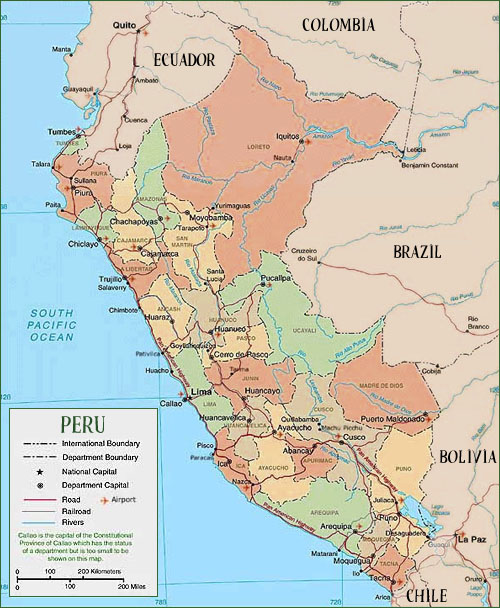
Al, Mary, Ron, and Verna arrived in the early morning on Tuesday, April 18th. After a few days of hanging around in Arequipa, walking in the fields and eating in "typical" restaurants, we were ready to begin our journey. The trip had been sketched out in advance, but due to a few miscommunications between the travel agent and myself, as well as my stubborness on a couple of points, we didn't have the whole thing finalized until about two days before we left. It felt a little nerve-wracking at the time, but come morning on Saturday, April 22, we were sitting in a bus bound for Puno, on the shores of Lake Titicaca. To get a sense of the trip, I offer you this map. Find Arequipa in the bottom bit of Peru, on a green background. Puno is up and to the right. Cusco is about an inch straight up from Arequipa. Oriented? Good. Okay, so off we went on the bus.
Main features of the bus ride:
* An eerie preoccupation with security that prompted the company to camcord all of us as we entered the bus;
* Completely non-functional air conditioning
* A snack that consisted of crackers, bread, a biscuit, and Diet Inca Kola,
* Such great American films as I Spy and Men In Black played at top volume over the entertainment system,
* Bingo - a game which only those making a round trip could play, because the prizes would be given out on the way back to Arequipa.
A few shots from the bus ride:


Note the smoke rising in the last shot. That is the volcano Ubinas, located some 270 kilometres from Arequipa, considered one of Peru's most active volcanoes. It began to erupt in March, and reached its peak just the day before we went on our trip; the village at the base of the volcano was evacuated the same weekend we made our journey. Volcanic ash was causing health problems for the residents, and a few dozen llamas, alpacas, and vicuñas had died.
And then the bus broke down. We sat on the side of the road by a stream for about an hour and had lunch, which in a way was the best thing that could have happened to us; it was cooler outside the bus than in, and the kids had the chance to roam around for a while.


Eventually, two buses from other companies showed up and the passengers were split between the two. In the confusion, one of our bags was left on the broken-down bus, and there ended up being too many people on the new bus, so some were obliged to stand. We were also required to pay cash for our new bus ride, which would be reimbursed by our own bus company at the station once we arrived in Puno. There was some discussion amongst us as to whether we would actually be reimbursed, but we payed and got on our way. I personally found the new bus far more comfortable than the old one - no annoying music, open windows, fresher air - but eventually the road became quite bad and bumpy. The boys slept for a while on the new bus, which they hadn't been able to do on the original one, which was also a blessing. We have Mary to thank for Joffre's long nap, as she pulled out all the stops with fairy tales and nursery rhymes to keep him occupied. Then, when he woke up, she sang with him and kept him from getting too cranky.
After we passed through Juliaca, an uninspired industrial town that hosts the nearest airport to Lake Titicaca, we were more comfortable. Since we were now on a cheaper bus, many of the riders were not tourists on their way to the lake but locals on their way to Juliaca. For this reason, we now had considerably more room available. We finally pulled into Puno at around 4 or 4:30 in the afternoon. After a few moments' confusion in the bus station, we found the poor worried tour guide who had been waiting for us while we were delayed. Nobody, of course, had been able to tell him anything about our whereabouts, and he was worried he had somehow missed us. We got reimbursed for our second bus ride, but my bag had not turned up and so without further ado we hopped into our private minibus and headed out to our hotel, about 10 minutes outside of town. This hotel had only opened a week before, and is called Casa Andina Private Collection. It was pretty darned swanky, with a view of the lake, a classy bar, a huge roaring fireplace, and ridiculously large rooms. The Gunsons and the Keelers each got a room with two queen-sized beds, and our little family got a room with three queens.
Upon perusing the highly overpriced hotel menu, we decided to catch taxis into town for dinner and a bit of a tour around. A few of us were feeling the effects of being at some 4000 metres above sea level, so we were taking things fairly easy. We had dinner in a restaurant overlooking the main square, and then I picked up some diapers and toothbrushes, since those things had been in the missing bag. After warm baths and a stern word with the hotel staff who were apparently building new furniture directly under our window, we crashed hard. Those without small children stayed up for a bit longer and played cards, but everyone had an early night, as we had to be up at the crack of dawn to head out on the lake.
Al, Mary, Ron, and Verna arrived in the early morning on Tuesday, April 18th. After a few days of hanging around in Arequipa, walking in the fields and eating in "typical" restaurants, we were ready to begin our journey. The trip had been sketched out in advance, but due to a few miscommunications between the travel agent and myself, as well as my stubborness on a couple of points, we didn't have the whole thing finalized until about two days before we left. It felt a little nerve-wracking at the time, but come morning on Saturday, April 22, we were sitting in a bus bound for Puno, on the shores of Lake Titicaca. To get a sense of the trip, I offer you this map. Find Arequipa in the bottom bit of Peru, on a green background. Puno is up and to the right. Cusco is about an inch straight up from Arequipa. Oriented? Good. Okay, so off we went on the bus.
Main features of the bus ride:
* An eerie preoccupation with security that prompted the company to camcord all of us as we entered the bus;
* Completely non-functional air conditioning
* A snack that consisted of crackers, bread, a biscuit, and Diet Inca Kola,
* Such great American films as I Spy and Men In Black played at top volume over the entertainment system,
* Bingo - a game which only those making a round trip could play, because the prizes would be given out on the way back to Arequipa.
A few shots from the bus ride:

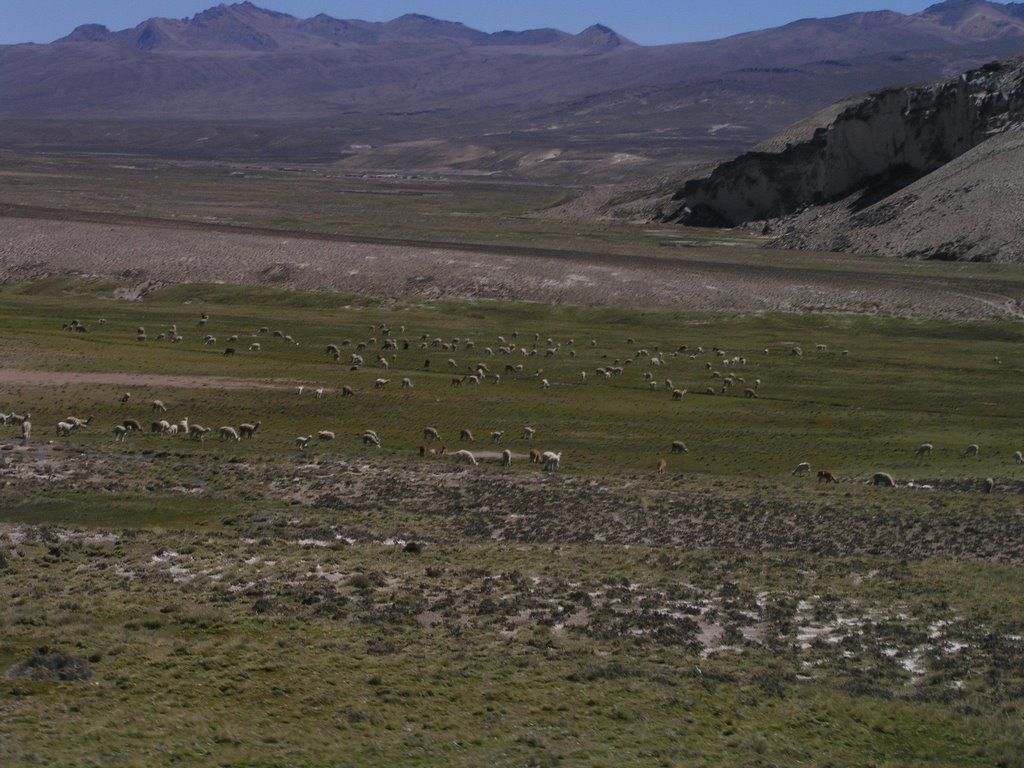

Note the smoke rising in the last shot. That is the volcano Ubinas, located some 270 kilometres from Arequipa, considered one of Peru's most active volcanoes. It began to erupt in March, and reached its peak just the day before we went on our trip; the village at the base of the volcano was evacuated the same weekend we made our journey. Volcanic ash was causing health problems for the residents, and a few dozen llamas, alpacas, and vicuñas had died.
And then the bus broke down. We sat on the side of the road by a stream for about an hour and had lunch, which in a way was the best thing that could have happened to us; it was cooler outside the bus than in, and the kids had the chance to roam around for a while.


Eventually, two buses from other companies showed up and the passengers were split between the two. In the confusion, one of our bags was left on the broken-down bus, and there ended up being too many people on the new bus, so some were obliged to stand. We were also required to pay cash for our new bus ride, which would be reimbursed by our own bus company at the station once we arrived in Puno. There was some discussion amongst us as to whether we would actually be reimbursed, but we payed and got on our way. I personally found the new bus far more comfortable than the old one - no annoying music, open windows, fresher air - but eventually the road became quite bad and bumpy. The boys slept for a while on the new bus, which they hadn't been able to do on the original one, which was also a blessing. We have Mary to thank for Joffre's long nap, as she pulled out all the stops with fairy tales and nursery rhymes to keep him occupied. Then, when he woke up, she sang with him and kept him from getting too cranky.
After we passed through Juliaca, an uninspired industrial town that hosts the nearest airport to Lake Titicaca, we were more comfortable. Since we were now on a cheaper bus, many of the riders were not tourists on their way to the lake but locals on their way to Juliaca. For this reason, we now had considerably more room available. We finally pulled into Puno at around 4 or 4:30 in the afternoon. After a few moments' confusion in the bus station, we found the poor worried tour guide who had been waiting for us while we were delayed. Nobody, of course, had been able to tell him anything about our whereabouts, and he was worried he had somehow missed us. We got reimbursed for our second bus ride, but my bag had not turned up and so without further ado we hopped into our private minibus and headed out to our hotel, about 10 minutes outside of town. This hotel had only opened a week before, and is called Casa Andina Private Collection. It was pretty darned swanky, with a view of the lake, a classy bar, a huge roaring fireplace, and ridiculously large rooms. The Gunsons and the Keelers each got a room with two queen-sized beds, and our little family got a room with three queens.
Upon perusing the highly overpriced hotel menu, we decided to catch taxis into town for dinner and a bit of a tour around. A few of us were feeling the effects of being at some 4000 metres above sea level, so we were taking things fairly easy. We had dinner in a restaurant overlooking the main square, and then I picked up some diapers and toothbrushes, since those things had been in the missing bag. After warm baths and a stern word with the hotel staff who were apparently building new furniture directly under our window, we crashed hard. Those without small children stayed up for a bit longer and played cards, but everyone had an early night, as we had to be up at the crack of dawn to head out on the lake.
Thursday, May 25, 2006
And Then Baby Got Sick
We all got colds on our trip (yes, the big story about that is still to come). And then we all developed lingering chest coughs, that I'm reasonably certain indicate bronchitis. We all still have those coughs. So, when I took Alec to our shiny new pediatrician the day after his first birthday to see about his one year immunizations, she listened to his chest and said she wouldn't vaccinate until he got over the cough. She prescribed pediatric cough syrup and infant ibuprofen, and sent us on our way. That was a week ago today.
For three days, Alec took his meds and coughed anyway. Then Monday morning at 4, he sat up in bed and vomited. And kept vomiting. At first I wasn't too worried, because he has always had a sensitive tummy and and has already puked far more in one year than Joffre has in 3.5. Heck, he had three nights in a row after we got back from our trip where he was throwing up every night. But, by about 10 am Monday, when he started throwing up chemical-yellow bile, I got a bit worried and called the pediatrician's office. The pediatrician herself was not in (because of the paro, according to the receptionist), but I could call her on her cellphone. So, thinking that was pretty cool, I called her on her cellphone. She answered, and told me that she was in LIMA. Now, it's enough of a stretch to think that you might call your doctor's office in Vancouver on, say, a Storm Day (see post on same), be told by the receptionist that she wasn't coming in, and be given her pager number, let alone her cell number. But if that doctor had travelled to Calgary, would she still take a call from a patient? I don't think so. Anyway, the doctor told me to give Alec Children's Gravol suppositories to stop the vomiting and Pedialyte to rehydrate him. She also told me to take him off the medication we'd been giving him for the cough. She said to take him to the clinic if the vomiting didn't stop. After I got off the phone, I thought, "Gravol suppositories? Really?" Being me, I looked Gravol up online and found absolutely nothing to suggest that the suppositories were meant to be used on babies.
So, I cracked out our supply of rehydration salts, mixed some up, and discovered that - surprise! - the baby thought they were vile and wouldn't drink them. I decided to keep a close eye on him, and if he showed signs of really being sick, or of dehydration, I would get some of this Gravol. I got clear Gatorade and cut it with water, and that he drank. He threw up less frequently over the course of the day, so I thought we were in the clear. However, at ten Monday night, he started seriously vomiting again. Fearing another sleepless night, I gave him one quarter of a Children's Gravol that we had in our medicine kit - the tablets have the same amount of drug as the suppositories, so I felt I was being cautious enough - and he slept through until about 4 am, when he started throwing up again. Oh, and that was our anniversary.
Tuesday now, and I felt that Alec was basically doing okay. Plus, the paro was over, so I knew we could get wherever we needed to. He seemed fine for most of the morning, and then around noon it all went sideways and the vomiting began again in earnest. Our power also went out at about two in the afternoon, and at five showed no signs of returning. The whole district was out. I went out to buy the dreaded suppositories, and candles, and while out I ran into a fellow expat who told me that in her opinion I should be taking this kid to the hospital. So, I called up our lady at the company, and asked her where I should take him. Bless her heart, she came to our house at 6 - shortly after the power came back on - and took me to the clinic. In the clinic parking lot, however, she decided that it would take too long to go through admitting and a general doctor before getting through to pediatrics, so she called up her own pediatrician, confirmed that he was seeing patients, and took us over there. This doctor, who was at least eighty years old and completely unintelligible in Spanish or English, checked Alec over very thoroughly - there are no digital, under-the-arm baby thermometers here, I tell you - and pronounced him fever-free, not dehydrated, and suffering from bronchitis. He advised me to put baby back on the cough syrup, give him tylenol should a fever develop, and give him ten drops of Children's Gravol liquid every eight hours to stop the vomiting. He recommended rice water to keep him hydrated, which Alec miraculously enjoyed. He also gave us a form asking for various tests and gave us instructions to take a diaper in to a lab downtown for stool analysis the next day. Alec had a messy diaper at 3:00 Wednesday morning, and then seemed fine. He would not, however, take the Gravol drops. We ended up mixing it into a teaspoon of honey to get it in there. This tactic backfired, as now he won't take any medicine at all that isn't mixed with honey.
Wednesday I took the stool sample in to the lab. As with the doctors' offices, I was required to pay cash - in advance - for this service, so I now have a little stack of receipts from various consults and prescriptions waiting to be submitted to our health insurance company. The lab told me they would have the results for me to pick up after two pm. Sure enough, at 2:30 there was a little envelope waiting for me with Alec's name on it. His diaper had shown that he had no parasites or abnormalities, but that he was suffering from rotavirus. Which sounds scary, but is in fact the leading cause of vomiting and diarrhea in children three and under in developed countries, and common as dirt. By now, Alec was eating some solids again, and hadn't thrown up in 12 hours. We went to the playground with friends for a while, and that evening went back to the pediatrician's office to show him the test results. He said, "well, the kid seems better, so keep doing what you're doing, and everything should be fine."
Thursday - yesterday - Alec was cranky and restless all day, but didn't throw up. He didn't want to nurse and didn't want to sleep, and this was strange, as throughout his tummy illness he had remained happy, playful, and cuddly. He fell asleep well last night, by 8:00, and slept till about 11 before he started to toss and turn. He slept fitfully, waking us up regularly but not waking up himself, until about 3. He hadn't nursed since around four in the afternoon, and now he had a fever. So, I got some ibuprofen into him, stripped off the outer layer of pyjamas the housekeeper had bundled him into, and fed him a couple of ounces of Gatorade/water. At 4:30 he decided to nurse, and at 5:30 someone on the street started incessantly honking a horn.
Throughout all of this, I have had some kind of bronchitis - or at least, lingering chest cough - and am now painfully exhausted from a week of Very Bad Sleep. So, I will likely be going to the doctor too. Fortunately, my take on doctors here is that they are friendly, knowledgeable, and efficient, even if they are not using all the fancy electronic equipment that we know from home. Unfortunately, I think that my scepticism about the Gravol and my hesitance in taking him to the doctor at all has branded me a "bad and rebellious patient" in the eyes of the medical professionals here, who are accustomed to being able to say, "I'm going to give you a shot for that," or "take this three times a day for five days" without being questioned as to the exact nature of the drug.
Peruvians, like many Canadians, seem to feel that the slightest sign of illness with a cold or a flu is the cue to get oneself to the doctor's office post haste. The doctors, though, seem far more likely to recommend cough and cold pills and syrups that we can buy over the counter in Canada than Canadian doctors are. I'm tired of hearing everyone, from people on the street to the doctors and nurses themselves, blaming the rash of coughs and sniffly noses on the "change in the weather" and the "extreme cold" (never below 7-8 degrees C), even when they also talk about viruses.
And, of course, here as elsewhere, the average person seems to think that antibiotics are a magic bullet that will eradicate any and all illness. The tired resignation in the doctor's voice when he said, "rotavirus is a virus and can't be treated with antibiotics" suggested that he had said it several hundred times before, and had generally met with protest from patients. I hope I gained a few points back, after my anti-Gravol performance, when I said I understood that and was happy to continue treating symptoms till the virus had run its course.
Now, as long and the darned fever doesn't repeat itself. I could really use a good night's sleep.
For three days, Alec took his meds and coughed anyway. Then Monday morning at 4, he sat up in bed and vomited. And kept vomiting. At first I wasn't too worried, because he has always had a sensitive tummy and and has already puked far more in one year than Joffre has in 3.5. Heck, he had three nights in a row after we got back from our trip where he was throwing up every night. But, by about 10 am Monday, when he started throwing up chemical-yellow bile, I got a bit worried and called the pediatrician's office. The pediatrician herself was not in (because of the paro, according to the receptionist), but I could call her on her cellphone. So, thinking that was pretty cool, I called her on her cellphone. She answered, and told me that she was in LIMA. Now, it's enough of a stretch to think that you might call your doctor's office in Vancouver on, say, a Storm Day (see post on same), be told by the receptionist that she wasn't coming in, and be given her pager number, let alone her cell number. But if that doctor had travelled to Calgary, would she still take a call from a patient? I don't think so. Anyway, the doctor told me to give Alec Children's Gravol suppositories to stop the vomiting and Pedialyte to rehydrate him. She also told me to take him off the medication we'd been giving him for the cough. She said to take him to the clinic if the vomiting didn't stop. After I got off the phone, I thought, "Gravol suppositories? Really?" Being me, I looked Gravol up online and found absolutely nothing to suggest that the suppositories were meant to be used on babies.
So, I cracked out our supply of rehydration salts, mixed some up, and discovered that - surprise! - the baby thought they were vile and wouldn't drink them. I decided to keep a close eye on him, and if he showed signs of really being sick, or of dehydration, I would get some of this Gravol. I got clear Gatorade and cut it with water, and that he drank. He threw up less frequently over the course of the day, so I thought we were in the clear. However, at ten Monday night, he started seriously vomiting again. Fearing another sleepless night, I gave him one quarter of a Children's Gravol that we had in our medicine kit - the tablets have the same amount of drug as the suppositories, so I felt I was being cautious enough - and he slept through until about 4 am, when he started throwing up again. Oh, and that was our anniversary.
Tuesday now, and I felt that Alec was basically doing okay. Plus, the paro was over, so I knew we could get wherever we needed to. He seemed fine for most of the morning, and then around noon it all went sideways and the vomiting began again in earnest. Our power also went out at about two in the afternoon, and at five showed no signs of returning. The whole district was out. I went out to buy the dreaded suppositories, and candles, and while out I ran into a fellow expat who told me that in her opinion I should be taking this kid to the hospital. So, I called up our lady at the company, and asked her where I should take him. Bless her heart, she came to our house at 6 - shortly after the power came back on - and took me to the clinic. In the clinic parking lot, however, she decided that it would take too long to go through admitting and a general doctor before getting through to pediatrics, so she called up her own pediatrician, confirmed that he was seeing patients, and took us over there. This doctor, who was at least eighty years old and completely unintelligible in Spanish or English, checked Alec over very thoroughly - there are no digital, under-the-arm baby thermometers here, I tell you - and pronounced him fever-free, not dehydrated, and suffering from bronchitis. He advised me to put baby back on the cough syrup, give him tylenol should a fever develop, and give him ten drops of Children's Gravol liquid every eight hours to stop the vomiting. He recommended rice water to keep him hydrated, which Alec miraculously enjoyed. He also gave us a form asking for various tests and gave us instructions to take a diaper in to a lab downtown for stool analysis the next day. Alec had a messy diaper at 3:00 Wednesday morning, and then seemed fine. He would not, however, take the Gravol drops. We ended up mixing it into a teaspoon of honey to get it in there. This tactic backfired, as now he won't take any medicine at all that isn't mixed with honey.
Wednesday I took the stool sample in to the lab. As with the doctors' offices, I was required to pay cash - in advance - for this service, so I now have a little stack of receipts from various consults and prescriptions waiting to be submitted to our health insurance company. The lab told me they would have the results for me to pick up after two pm. Sure enough, at 2:30 there was a little envelope waiting for me with Alec's name on it. His diaper had shown that he had no parasites or abnormalities, but that he was suffering from rotavirus. Which sounds scary, but is in fact the leading cause of vomiting and diarrhea in children three and under in developed countries, and common as dirt. By now, Alec was eating some solids again, and hadn't thrown up in 12 hours. We went to the playground with friends for a while, and that evening went back to the pediatrician's office to show him the test results. He said, "well, the kid seems better, so keep doing what you're doing, and everything should be fine."
Thursday - yesterday - Alec was cranky and restless all day, but didn't throw up. He didn't want to nurse and didn't want to sleep, and this was strange, as throughout his tummy illness he had remained happy, playful, and cuddly. He fell asleep well last night, by 8:00, and slept till about 11 before he started to toss and turn. He slept fitfully, waking us up regularly but not waking up himself, until about 3. He hadn't nursed since around four in the afternoon, and now he had a fever. So, I got some ibuprofen into him, stripped off the outer layer of pyjamas the housekeeper had bundled him into, and fed him a couple of ounces of Gatorade/water. At 4:30 he decided to nurse, and at 5:30 someone on the street started incessantly honking a horn.
Throughout all of this, I have had some kind of bronchitis - or at least, lingering chest cough - and am now painfully exhausted from a week of Very Bad Sleep. So, I will likely be going to the doctor too. Fortunately, my take on doctors here is that they are friendly, knowledgeable, and efficient, even if they are not using all the fancy electronic equipment that we know from home. Unfortunately, I think that my scepticism about the Gravol and my hesitance in taking him to the doctor at all has branded me a "bad and rebellious patient" in the eyes of the medical professionals here, who are accustomed to being able to say, "I'm going to give you a shot for that," or "take this three times a day for five days" without being questioned as to the exact nature of the drug.
Peruvians, like many Canadians, seem to feel that the slightest sign of illness with a cold or a flu is the cue to get oneself to the doctor's office post haste. The doctors, though, seem far more likely to recommend cough and cold pills and syrups that we can buy over the counter in Canada than Canadian doctors are. I'm tired of hearing everyone, from people on the street to the doctors and nurses themselves, blaming the rash of coughs and sniffly noses on the "change in the weather" and the "extreme cold" (never below 7-8 degrees C), even when they also talk about viruses.
And, of course, here as elsewhere, the average person seems to think that antibiotics are a magic bullet that will eradicate any and all illness. The tired resignation in the doctor's voice when he said, "rotavirus is a virus and can't be treated with antibiotics" suggested that he had said it several hundred times before, and had generally met with protest from patients. I hope I gained a few points back, after my anti-Gravol performance, when I said I understood that and was happy to continue treating symptoms till the virus had run its course.
Now, as long and the darned fever doesn't repeat itself. I could really use a good night's sleep.
My Japanese Soul Mate
So, one aspect of living in a different country is that there are certain foods and ingredients that aren't available. Strangely, this inevitably makes us crave those foods and ingredients, and we go to great lengths to create, find, import, or substitute. Although I'm happy to wing, say a roast, casserole, or soup, I'm less willing to gamble on my powers of invention when it comes to sushi rice, DongPo Rou, enchilada sauce, Chinese BBQ Pork, and Pork Buns.
Of course, I didn't bring an Asian cookbook to Peru with me, so I must Google all recipes. And what I discovered quickly was that many of these recipes required ingredients that can't be found in Arequipa: rice wine, rice vinegar, peanut oil, cooking sherry, white pepper, and a million others. Aaron went to Lima this week and brought back a bunch of stuff, but some things are unattainable. Again, the internet came to my rescue, as I am able to Google ingredient substitutes. Here I learned two amazing things. The first is that there is a thriving community of hip, urban vegans/observant Jews/observant Muslims out there who want to be able to make the most authentic tasting vegan/kosher/halal oyster sauce, marinades, and steamed dim sum around. My hat is off to them and their wordly tastebuds, without which I would never have been able to concoct oyster-free oyster sauce, sherry-free Dong Po Pork, sake-free Japanese marinades, and fish-flake-free miso soup base.
The second thing I learned is that there is a thriving food blog community out there. This, frankly, should come as no surprise to me, but I was a bit taken aback to discover that there are people more obsessed with food than I am. My new favorite is I Was Just Really Very Hungry. She pops up time and again when I search for good recipes for Chinese and Japanese food, and I feel I've found a kindred spirit.
Oh, big acknowledgements are also due to the vibrant online homesteaders, as I think of them - the people who post recipes for the homemade everything they make. Without them, I would never have learned to make my own sour cream, buttermilk (we'll see how it turns out) or toothpaste. Actually, I think I'll skip making that last one. There's plenty of Colgate in Peru. But it's interesting to know that if I really needed to, I'd be able to find an online recipe.
Of course, I didn't bring an Asian cookbook to Peru with me, so I must Google all recipes. And what I discovered quickly was that many of these recipes required ingredients that can't be found in Arequipa: rice wine, rice vinegar, peanut oil, cooking sherry, white pepper, and a million others. Aaron went to Lima this week and brought back a bunch of stuff, but some things are unattainable. Again, the internet came to my rescue, as I am able to Google ingredient substitutes. Here I learned two amazing things. The first is that there is a thriving community of hip, urban vegans/observant Jews/observant Muslims out there who want to be able to make the most authentic tasting vegan/kosher/halal oyster sauce, marinades, and steamed dim sum around. My hat is off to them and their wordly tastebuds, without which I would never have been able to concoct oyster-free oyster sauce, sherry-free Dong Po Pork, sake-free Japanese marinades, and fish-flake-free miso soup base.
The second thing I learned is that there is a thriving food blog community out there. This, frankly, should come as no surprise to me, but I was a bit taken aback to discover that there are people more obsessed with food than I am. My new favorite is I Was Just Really Very Hungry. She pops up time and again when I search for good recipes for Chinese and Japanese food, and I feel I've found a kindred spirit.
Oh, big acknowledgements are also due to the vibrant online homesteaders, as I think of them - the people who post recipes for the homemade everything they make. Without them, I would never have learned to make my own sour cream, buttermilk (we'll see how it turns out) or toothpaste. Actually, I think I'll skip making that last one. There's plenty of Colgate in Peru. But it's interesting to know that if I really needed to, I'd be able to find an online recipe.
Illogic
There's a whitewashed wall that we drive past on our way home from downtown, which someone has painted with the following phrase in big bold red and black: "¡ESTE TERRENO NO SE VENDE! 555-123" Which of course means "THIS LOT IS NOT FOR SALE! 555-123." And this is hilarious to me. So one day, I was laughing about it, in a taxi, and I said to the taxi driver, "Why would this person paint on their wall that the land isn't for sale?" The cabby said, "Maybe people keep trying to buy it." I said, "Okay, but then wouldn't it make more sense not to put your phone number up?" What possible reason could there be for offering your phone number when you don't want people to call you?
Monday, May 22, 2006
How to Have a Storm Day When the Weather's Always Perfect
You know that feeling, the one you get when you wake up in the dusky light of a winter morning, to see that snow has fallen - snow on snow - and continues to fall, and you shuffle over to the kettle in your jammies and slippers, fill a mug with tea, and flip the radio on to see what schools are closed for the day, and if the highways are shut down, and when you discover that they are, you know that a day full of reading, playing quiet games, and eating comfort foods awaits, as you are absolved of all responsibility to go out and be a Productive Member of our Busy Society? Or is that just me? Does anybody else get a bit excited when the power goes out (giant ice storms notwithstanding)?
Here in Arequipa, where every single day is sunny and sees a high of 25 (C) and a low of 8 (C), storm days are unlikely to happen. Fortunately, we have something called a paro, which is like a strike only done by bus and taxi drivers (parar is to stop). Traffic mostly stops, especially into and out of the centre of town, thanks to protesting drivers who lob bricks and rocks at those breaking the paro, as well as makeshift road blocks of broken glass and nails. There is almost no traffic in our street today, my Spanish teacher has cancelled our lesson for the afternoon, and Joffre was the only kid in his class at school today; they told us to just have him stay home tomorrow if the paro continues.
Oh, they say it's to protest the recent increase in gas tax, as well as the tariffs or "tributes" that they must pay to the municipal government, but when my Peruvian friend called me today and knowingly said, "so, taking it easy, having a quiet day at home today?", it gave the game away. I know Storm Day Envy when I see it.
Here in Arequipa, where every single day is sunny and sees a high of 25 (C) and a low of 8 (C), storm days are unlikely to happen. Fortunately, we have something called a paro, which is like a strike only done by bus and taxi drivers (parar is to stop). Traffic mostly stops, especially into and out of the centre of town, thanks to protesting drivers who lob bricks and rocks at those breaking the paro, as well as makeshift road blocks of broken glass and nails. There is almost no traffic in our street today, my Spanish teacher has cancelled our lesson for the afternoon, and Joffre was the only kid in his class at school today; they told us to just have him stay home tomorrow if the paro continues.
Oh, they say it's to protest the recent increase in gas tax, as well as the tariffs or "tributes" that they must pay to the municipal government, but when my Peruvian friend called me today and knowingly said, "so, taking it easy, having a quiet day at home today?", it gave the game away. I know Storm Day Envy when I see it.
To Ubicate
I have discovered a new favorite Peruvian/Spanish verb: ubicarse. It means "to find oneself," and not in an existential way. When we are driving in the taxi, the dispatcher comes on the radio to ask different cars where they ubicate themselves. You might ask where a restaurant, store, or park is using ubicarse: "¿Dónde se ubica el restaurante?", or you might demand to know where your friend is when she's running a half hour late: "¿Dónde te ubicas?"
What's funny is that Spanish already has encontrarse, which is more literally "to find oneself" (still not existentially). According to my Spanish teacher, it's a fairly local expression. I tried to explain about "ubiquitous" in English, but somehow saying, "you know, when something is all around, or when you keep seeing the same things everywhere," didn't fully convey the meaning of the word.
What's funny is that Spanish already has encontrarse, which is more literally "to find oneself" (still not existentially). According to my Spanish teacher, it's a fairly local expression. I tried to explain about "ubiquitous" in English, but somehow saying, "you know, when something is all around, or when you keep seeing the same things everywhere," didn't fully convey the meaning of the word.
Peruvian Whine
No, not the cutesy Green College spelling of wine, but actual whining. It's a strange fact that in Peru, when someone is asking for a favour or saying something in a supplicating, obsequious fashion, he or she will use a wheedling, high-pitched, whiney tone of voice. Almost like baby talk. It drives foreigners nuts, because it sounds like whining, but it is - among local people - a respectful and self-deprecating way to speak. It is mostly used by women and children, in my experience, and is virtually always used when one asks to borrow something. So, when a little kid in the street comes up to you and whines "buy some gum from me," he isn't being bratty but respectfully subservient.
Si sí no fuera sí sino si . . .
Today I was walking up from taking Joffre to school and I saw a guy wearing a t-shirt that had a picture of Bush and Saddam Hussein, with a peace symbol superimposed over their faces, and the phrase "Not to the war, If to the peace." You see, "no" in Spanish can mean no or not, depending on the context, and "si" means if, while "sí" (note the accent) means yes. So, I could si where the t-shirt maker was coming from.
Oh, yeah, we went to Machu Picchu and Lake Titicaca, only not in that order. I will write about that soon. Promise.
Oh, yeah, we went to Machu Picchu and Lake Titicaca, only not in that order. I will write about that soon. Promise.
Friday, April 21, 2006
Machu Picchu Bound
Well, if you are looking for us over the next 10 days, we will be on a quest to master our powers of concentration and say "Lake Titicaca" without stuttering or smirking.
We will be visiting Lake Titicaca (*grin*), Cuzco, the Sacred Valley, and Machu Picchu, before flying back here.
I will post pictures and a travel story, although I make no promises about when you might expect those to turn up.
We will be visiting Lake Titicaca (*grin*), Cuzco, the Sacred Valley, and Machu Picchu, before flying back here.
I will post pictures and a travel story, although I make no promises about when you might expect those to turn up.
Monday, April 10, 2006
A Walk in the Andenes
Several weeks ago, we went walking in the fields behind our house, with two purposes: to see the church that is visible from the house, and to see wher ethe irrigation water comes from. We managed the first, but not the second. It was a long walk, and Joffre is proving to have the stamina of his grandfathers when it comes to walking, since he mostly did it all himself. Pretty darned impressive for a three-year-old.


For loads more pictures from this walk, click here.


For loads more pictures from this walk, click here.
Sunday, April 09, 2006
Yes, We Have No Camarones
I do speak Spanish, but there were a lot of words that I didn't know before coming here - either because they weren't taught in my Spanish classes or because they are uniquely Peruvian - that I've since picked up. One of the first of these words was "veda", which means "ban." This is because there is a ban on fishing for one of the region's greatest delicacies, river shrimp or camarones. So, most of the restaurants one visits have all these shrimp dishes on the menu, and when you attempt to order them, you are informed that camarones are in veda, and can they bring you some langostinos instead? Langostinos, which could be translated as "little lobsters", are ocean prawns of the sort that one can buy (frozen, two bags for the price of one) in any Safeway in Canada. Only fresh, and big and juicy.
The sordid scandal here is that there is illegal fishing of camarones, in spite of the depleted stocks, and some restaurants continue to serve them. On top of this, if one visits the fish market, one will be approached by shifty-eyed old ladies whispering, "buscas camarones, caserita?" I keep expecting them to offer me a letter W, and it's all I can do not to broadcast, "why, YES, I'd love some camarones, especially since they're so scarce these days!" I was actually with a couple of ladies when they bought some, and we followed the woman (with our security guard in embarrassed tow) down several twisty turnings through the labyrinth of the market, to an unmarked corrugated iron door, through which they passed and from which they emerged some time later with ominous-looking black plastic bags.
All this for illegally-obtained river shrimp which are, in my blasphemous opinion, kind of marshy-tasting and not as good as plain old legal prawns.
The sordid scandal here is that there is illegal fishing of camarones, in spite of the depleted stocks, and some restaurants continue to serve them. On top of this, if one visits the fish market, one will be approached by shifty-eyed old ladies whispering, "buscas camarones, caserita?" I keep expecting them to offer me a letter W, and it's all I can do not to broadcast, "why, YES, I'd love some camarones, especially since they're so scarce these days!" I was actually with a couple of ladies when they bought some, and we followed the woman (with our security guard in embarrassed tow) down several twisty turnings through the labyrinth of the market, to an unmarked corrugated iron door, through which they passed and from which they emerged some time later with ominous-looking black plastic bags.
All this for illegally-obtained river shrimp which are, in my blasphemous opinion, kind of marshy-tasting and not as good as plain old legal prawns.
The Fanged Wonder
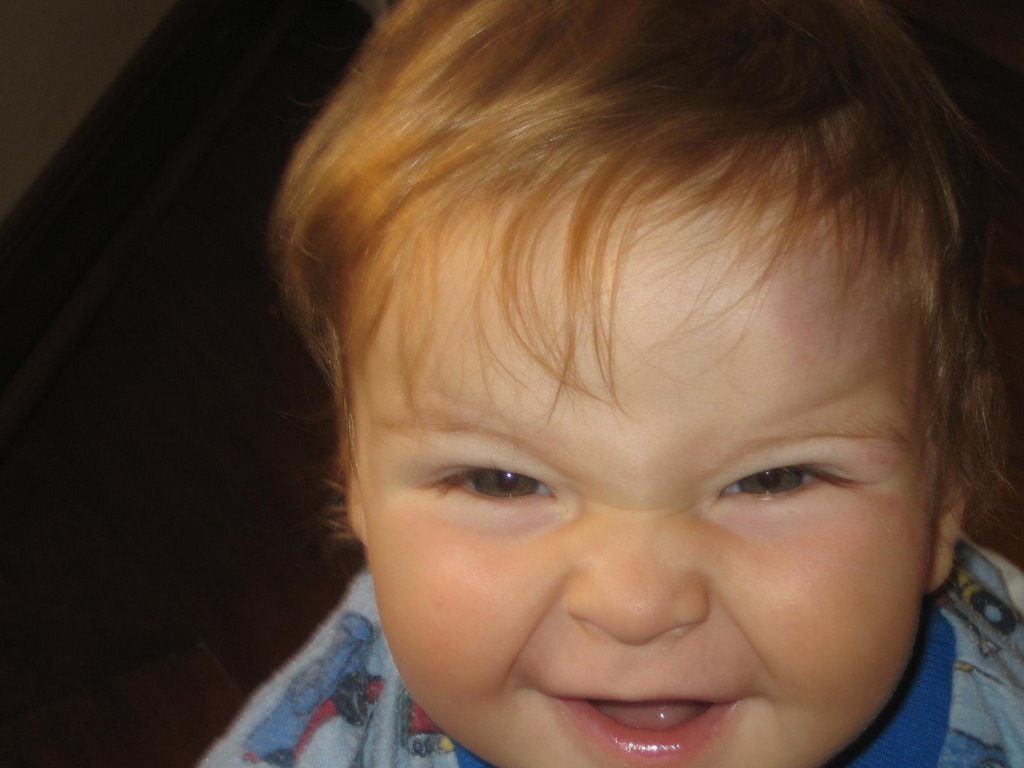
Alec's second fang came in. They aren't actually his canines, they're his lateral incisors, but that fact doesn't stop him from looking as though his first words ought to be "I vant to suck your blod!"


Seriously, he's like a rosy, blond little Grandpa Munster.
He actually has three more teeth coming in right now, his middle top two and one beside his bottom ones, so we had to get photographic evidence quickly before the effect was forever lost.


Seriously, he's like a rosy, blond little Grandpa Munster.
He actually has three more teeth coming in right now, his middle top two and one beside his bottom ones, so we had to get photographic evidence quickly before the effect was forever lost.
Head Damage
First, allow me to apologize for the hiatus in posting - I'll try not to let it happen again, but one does get so busy . . .
Alec has his Very Own Bed now, thanks to a nasty bonking incident a few weeks ago. He took a nose dive off the bed (2.5 feet in height) at about 5:20 am, so I woke up to the sound of baby head hitting wood-on-concrete floor. Not fun. There was a lot of crying, but he got calmed down, scowled and squirmed appropriately when I shone a flashlight in his eyes, ate his breakfast, and was soon berating the cows out the bedroom window (his latest favorite activity).

Not to be outdone, Joffre has since taken two headers from beds - his own and ours - and in one incident clipped his right eyelid on the corner of the bedside table, producing impressive bruising. So, you know, the folks at the preschool are keeping an eye on me now.
Then we were out for lunch one fine Sunday afternoon, and all of a sudden all the words on the left side of my menu disappeared. They came back right away, so I assumed it was a trick of the light. While we were eating, however, I developed a nasty stabbing headache, which I endeavored to ignore. As we finished the meal, I lost the feeling in my left arm and the left side of my face, which I of course assumed was a stroke. Some feeling came back, but it felt strange for a while. The doctor at emergency decided it was a migraine. If I never get another one, it will be too soon. The doctor announced that he was going to give me two injections, one for the pain and one for the nausea, but I politely (I hope) told him Advil would be fine, went home, took said medication, and slept for three hours.
I had heard before that spouses of migraine sufferers often developed them too, but I'd chalked it up to urban legend. Drat.
Alec has his Very Own Bed now, thanks to a nasty bonking incident a few weeks ago. He took a nose dive off the bed (2.5 feet in height) at about 5:20 am, so I woke up to the sound of baby head hitting wood-on-concrete floor. Not fun. There was a lot of crying, but he got calmed down, scowled and squirmed appropriately when I shone a flashlight in his eyes, ate his breakfast, and was soon berating the cows out the bedroom window (his latest favorite activity).
Not to be outdone, Joffre has since taken two headers from beds - his own and ours - and in one incident clipped his right eyelid on the corner of the bedside table, producing impressive bruising. So, you know, the folks at the preschool are keeping an eye on me now.
Then we were out for lunch one fine Sunday afternoon, and all of a sudden all the words on the left side of my menu disappeared. They came back right away, so I assumed it was a trick of the light. While we were eating, however, I developed a nasty stabbing headache, which I endeavored to ignore. As we finished the meal, I lost the feeling in my left arm and the left side of my face, which I of course assumed was a stroke. Some feeling came back, but it felt strange for a while. The doctor at emergency decided it was a migraine. If I never get another one, it will be too soon. The doctor announced that he was going to give me two injections, one for the pain and one for the nausea, but I politely (I hope) told him Advil would be fine, went home, took said medication, and slept for three hours.
I had heard before that spouses of migraine sufferers often developed them too, but I'd chalked it up to urban legend. Drat.
Thursday, March 23, 2006
Fine Peruvian Craftsmanship
We brought our travelling high chair, which attaches to a regular chair, to Peru with us. However, the chairs at the house here have this beautiful leather upholstery, so we couldn't bring ourselves to strap the high chair to one. I went out shopping with a local lady to buy a chair to host our seat, but couldn't find anything satisfactory. So, we bought a highchair instead. I had my choice of powder blue or red cushioning, so I chose red.

I didn't notice the SpongeBob SquarePants pattern till we were loading it into the vehicle.
It's a good high chair, but it needs a strap or something to go between his legs to keep him from sliding out.
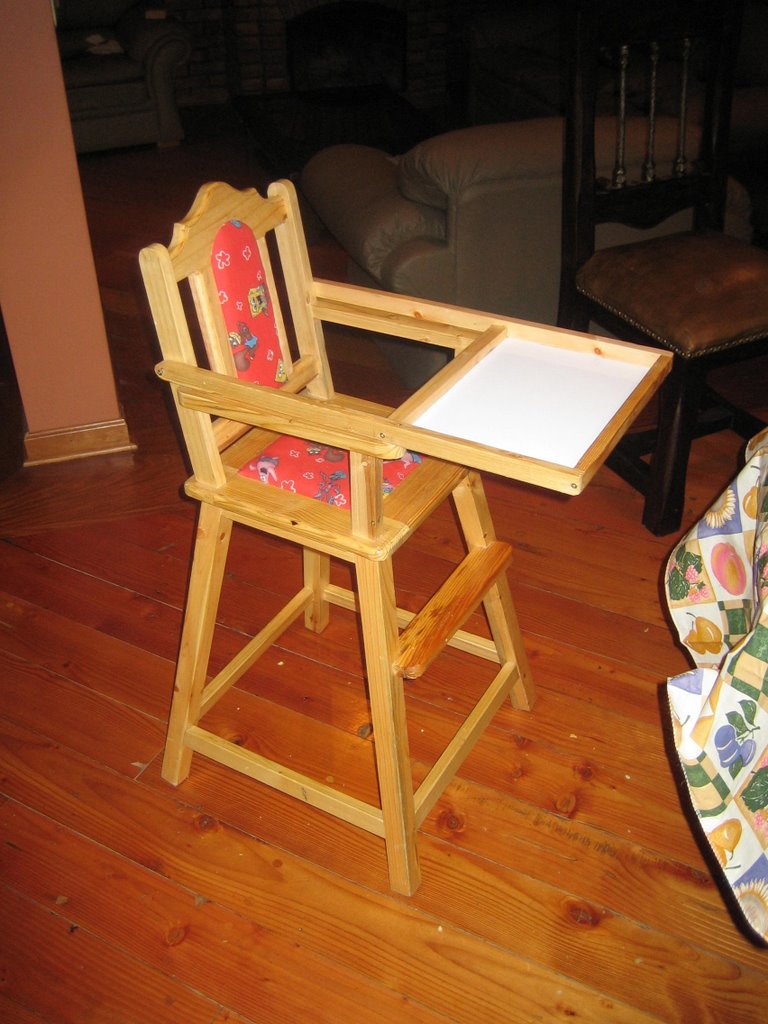
I didn't notice the SpongeBob SquarePants pattern till we were loading it into the vehicle.
It's a good high chair, but it needs a strap or something to go between his legs to keep him from sliding out.
When Words Collide
There's this wonderful verb in Spanish, picar. It can mean to pick at, or to mince, or to peck, or to itch in a prickly sort of way, or to nibble. From it come nouns like picadura, which is an insect bite or sting (although, when Alec's teeth are picando his gums, he doesn't pica when he bites, he muerdes), and picante, which of course means spicy - a dish that is spicy might be said to picar when you taste it. Picado means chopped or diced, picadillo is a hash, and picas are spades. Piqueos - at least, in Peru - are appetizers or, more directly translated, nibblies. Many restaurants translate the word even more directly when they draft their bilingual menus, and opt for the nearest cognate available. In this instance, however, it is a false cognate, and thus cheese plates, fried yuca, olives, garlic bread, and a host of other appetizers are advertised as "pickles." It makes sense - they are, after all, foods for picking at.
False cognates are great. Embarazada does not mean embarrassed, but rather pregnant. Sopa is not soap, but soup. To asistir is to attend. If you're all fired up, don't tell anyone in Spanish that you are excitado, because they will be shocked. Instead, you are emocionado. To recordar is to remember, while to record is grabar or anotar, depending on the context. Suceso is an event, not a success - when something goes extremely well, it is an éxito. An exit, however, is a salida, which should never be confused with an ensalada.
I knew all of these, but I couldn't understand why people kept smilingly offering me bland food. Turns out blando means soft, in a mushy food sort of way. And of course, Bimbo Blanco is not a flaky white person, but a brand of white bread produced by the multinational Mexican bakery Bimbo (think WonderBread). They tell me it's very blando.
False cognates are great. Embarazada does not mean embarrassed, but rather pregnant. Sopa is not soap, but soup. To asistir is to attend. If you're all fired up, don't tell anyone in Spanish that you are excitado, because they will be shocked. Instead, you are emocionado. To recordar is to remember, while to record is grabar or anotar, depending on the context. Suceso is an event, not a success - when something goes extremely well, it is an éxito. An exit, however, is a salida, which should never be confused with an ensalada.
I knew all of these, but I couldn't understand why people kept smilingly offering me bland food. Turns out blando means soft, in a mushy food sort of way. And of course, Bimbo Blanco is not a flaky white person, but a brand of white bread produced by the multinational Mexican bakery Bimbo (think WonderBread). They tell me it's very blando.
Friday, March 17, 2006
Random Foodstuffs I Can't Get Here
-Feta cheese . . . or any sort of cheese that would substitute for feta.
-Sour cream . . . well, that's not a suprise, and in any case you can fake sour cream.
-Plain yoghurt. Even the "natural" stuff contains vanilla and glucose.
-Berries. Seriously, raspberry and strawberry are two of the most popular flavours for yoghurt, jam, candy, and the like, and I have yet to see berries other than grapes in any market.
-Pine nuts. Not surprising, but I really want to buy some.
-Basil and rosemary (fresh) . . . and yet, basil is in lots of dishes, and I got dried rosemary, but I haven't found any fresh stuff for sale.
-Cheerios, or any cereal that ressembles them. Frosted flakes, corn flakes, rice krispies, a thousand granola varieties, but no cheerios.
-Juice concentrate. You can get fruit that is grown for making juice, you can get juice in bottles and tetrapaks, you can get powdered fruit-flavoured drink mix, but you can't get frozen or bottled juice concentrate.
-Salad dressing. Okay, admittedly I haven't really been looking for salad dressing, but I don't recall seeing it.
-Zucchini. Eggplant, sure. Cucumbers, you bet. Giant things that look like zucchini but are really some other squash variety with a hard peel, ubiquitous. Cute little courgettes? Not a chance.
-Chocolate chips for baking.
-Basmati or thai rice.
-Baking soda in anything larger than a 50 g packet.
Foodstuffs I Am Surprised to Find Available Here
-Quaker oatmeal, plain, vitamin fortified, and in the usual assortment of flavours
-Soy milk - very popular
-Cheddar cheese (in Canadian food dye orange)
-Sugarfree Trident gum
-Camembert cheese
-Philadelphia cream cheese
-Marshmallows, white and coloured, large and hot-chocolate-sized
-Soy and rice flour baked goods
-Arborio rice, and brown rice
-Snickers bars
Okay, that last one isn't that surprising.
I don't know why, but some days there are fresh mushrooms and asparagus at the markets and some days there are not. I mean, I would understand if asparagus was only in season at certain times, but it seems weird that it comes and goes almost weekly. Also, domestic white mushrooms don't really have a season, do they?
This Week's Winner of the "Strange and Foreign Product from a Familiar Company" Contest
Rasberry-scented Kleenex brand facial tissues, in a Winnie-the-Pooh box.
-Sour cream . . . well, that's not a suprise, and in any case you can fake sour cream.
-Plain yoghurt. Even the "natural" stuff contains vanilla and glucose.
-Berries. Seriously, raspberry and strawberry are two of the most popular flavours for yoghurt, jam, candy, and the like, and I have yet to see berries other than grapes in any market.
-Pine nuts. Not surprising, but I really want to buy some.
-Basil and rosemary (fresh) . . . and yet, basil is in lots of dishes, and I got dried rosemary, but I haven't found any fresh stuff for sale.
-Cheerios, or any cereal that ressembles them. Frosted flakes, corn flakes, rice krispies, a thousand granola varieties, but no cheerios.
-Juice concentrate. You can get fruit that is grown for making juice, you can get juice in bottles and tetrapaks, you can get powdered fruit-flavoured drink mix, but you can't get frozen or bottled juice concentrate.
-Salad dressing. Okay, admittedly I haven't really been looking for salad dressing, but I don't recall seeing it.
-Zucchini. Eggplant, sure. Cucumbers, you bet. Giant things that look like zucchini but are really some other squash variety with a hard peel, ubiquitous. Cute little courgettes? Not a chance.
-Chocolate chips for baking.
-Basmati or thai rice.
-Baking soda in anything larger than a 50 g packet.
Foodstuffs I Am Surprised to Find Available Here
-Quaker oatmeal, plain, vitamin fortified, and in the usual assortment of flavours
-Soy milk - very popular
-Cheddar cheese (in Canadian food dye orange)
-Sugarfree Trident gum
-Camembert cheese
-Philadelphia cream cheese
-Marshmallows, white and coloured, large and hot-chocolate-sized
-Soy and rice flour baked goods
-Arborio rice, and brown rice
-Snickers bars
Okay, that last one isn't that surprising.
I don't know why, but some days there are fresh mushrooms and asparagus at the markets and some days there are not. I mean, I would understand if asparagus was only in season at certain times, but it seems weird that it comes and goes almost weekly. Also, domestic white mushrooms don't really have a season, do they?
This Week's Winner of the "Strange and Foreign Product from a Familiar Company" Contest
Rasberry-scented Kleenex brand facial tissues, in a Winnie-the-Pooh box.
Tuesday, March 14, 2006
Scary Things When One is Wee
We went to the beach this past weekend. It's about a 1.5-2 hour drive from Arequipa, through absolutely desolate mountains and hills. Complete desert, not a sign of life except for irrigation projects and soft-drink sellers on the roadside. It's a whole lot of switchbacks, too, since in that 1.5 hours you go from 2350 m above sea level to, um, sea level.
The kids were great on the drive down. In fact, they both slept. We pulled into the town of Mollendo at about 1:00 in the afternoon and checked into a simple hotel. Our room, with four single beds, was on a tiled and flowery courtyard. We found a local restaurant where we ate corvina (a type of sea bass) for lunch, and then headed down to the beach for some fun in the sand.
The beach at Mollendo is not a swimming beach, thanks to the pounding, relentless surf and wicked undertow. Instead, it makes a perfectly acceptable spot for playing soccer, building sandcastles, and dipping one's toes. The Peruvian coast appears to be perpetually misty - Aaron tells me this is caused by the Humboldt Current, which comes from Antarctica. Even a block or two inland from the beach, it was blazingly hot, but it was refreshing right on shore.
Joffre had a blast, and got soaked by a couple of waves that came further inland than normal. Alec, on the other hand, barely held in there. He was terrified of the waves in the distance, which is logical, but he was also completely freaked out by the sand. The instant his toes touched it, he curled his legs up under his body and started whining. When he looked around and saw sand in every direction, he started to cry and tried to climb up my body onto my head. I got him relatively calm, but had to hold him the whole time we were at the beach and comfort him, as he was perpetually on the edge of a cry.
We headed back to our hotel to shower and rest a bit before dinner, and just to keep things interesting, Joffre stuck his fingers in the oscillating fan. Now, earlier, he'd been turning it on, then turning it off and sticking in his fingers to stop the blades once turned off, and we'd gotten after him and tried to explain how badly he could hurt himself. And he'd stopped earlier, so we figured we were in the clear. But then I was in the bathroom, and Aaron was changing Alec's diaper, and all of a sudden there was a terrible thudding noise and a blood-curdling scream, and I ran out of the bathroom and Joffre was screaming and dancing around in pain. In my panicky brain, I thought I saw blood spatters on the fan before I realized it was just rust. Nothing was broken or severed; he just bruised three fingers and opened one. Fortunately I'd had the presence of mind to bring a little first aid kit, so we got him cleaned up and bandaged, and gave him some kiddie Tylenol and an ice-cold water bottle to hold against the bruises.
Once Joffre was over the trauma, we went out to the town square, which as luck would have it was full of entertainment for children: climbing gyms, carousels, screened-in trampolines full of beach balls, and electric cars for children to ride around in. Each station charged about 1 sol for five or ten minutes of entertainment, so for the low low price of about $1.50 CDN we got a whole lot of Joffre fun before dinner.
We went to a restaurant that specialized in grilled meat and got the "complete platter", which consisted of chicken, beef heart, and tripe skewers, pork chops and steak - and was far more meat than we could eat - as well as potatoes and salad. For $10 CDN. We stuffed ourselves and then retired to the hotel, where we got the kids to sleep and then sat in the courtyard drinking a cool beer, smelling the night-blooming jasmine, and listening to the fretful wailing of the neighbours' three year old and baby. I'm pretty sure they were hating us, with our peaceful, sleeping angels. However, it is unlikely that their children woke them up at 5:30 the next morning . . .
Sunday morning Aaron and the kids let me sleep in until 7:20. They had already been up for quite some time, and Aaron discovered that along with sand, Alec is apparently terrified of goldfish - at least, of the grotesque, bulbous ones in the hotel fishtank. After a breakfast of rolls with butter and jam, coffee, and orange juice, we headed down to the beach. This time, we were instantly approached by touts wanting us to rent their beach umbrellas, which completely lined the shore. After a bit of discussion, we accepted an umbrella and two beach chairs for 10 soles, and a kiddie pool for 4 soles, which a man filled with sea water for Joffre's splashing enjoyment. Alec and I snuggled up in a beach chair and bought every bit of food wandering past - fry bread with syrup, cookies with dulce de leche, boiled eggs with hot sauce - while Aaron and Joffre went for a long explore up the beach. After Joffre was thoroughly drenched and the kiddie pool was full of sand, we headed back to the hotel and packed out. Another delicious dinner of corvina, and then we got picked up by the driver and came back to Arequipa. Alas, although Joffre was asleep before we had even gotten out of Mollendo, Alec cried and screamed for most of the drive home.
All in all, the beach was fun, but I am not sure we need to repeat it any time soon. After all, we have beaches in Vancouver!
The kids were great on the drive down. In fact, they both slept. We pulled into the town of Mollendo at about 1:00 in the afternoon and checked into a simple hotel. Our room, with four single beds, was on a tiled and flowery courtyard. We found a local restaurant where we ate corvina (a type of sea bass) for lunch, and then headed down to the beach for some fun in the sand.
The beach at Mollendo is not a swimming beach, thanks to the pounding, relentless surf and wicked undertow. Instead, it makes a perfectly acceptable spot for playing soccer, building sandcastles, and dipping one's toes. The Peruvian coast appears to be perpetually misty - Aaron tells me this is caused by the Humboldt Current, which comes from Antarctica. Even a block or two inland from the beach, it was blazingly hot, but it was refreshing right on shore.
Joffre had a blast, and got soaked by a couple of waves that came further inland than normal. Alec, on the other hand, barely held in there. He was terrified of the waves in the distance, which is logical, but he was also completely freaked out by the sand. The instant his toes touched it, he curled his legs up under his body and started whining. When he looked around and saw sand in every direction, he started to cry and tried to climb up my body onto my head. I got him relatively calm, but had to hold him the whole time we were at the beach and comfort him, as he was perpetually on the edge of a cry.
We headed back to our hotel to shower and rest a bit before dinner, and just to keep things interesting, Joffre stuck his fingers in the oscillating fan. Now, earlier, he'd been turning it on, then turning it off and sticking in his fingers to stop the blades once turned off, and we'd gotten after him and tried to explain how badly he could hurt himself. And he'd stopped earlier, so we figured we were in the clear. But then I was in the bathroom, and Aaron was changing Alec's diaper, and all of a sudden there was a terrible thudding noise and a blood-curdling scream, and I ran out of the bathroom and Joffre was screaming and dancing around in pain. In my panicky brain, I thought I saw blood spatters on the fan before I realized it was just rust. Nothing was broken or severed; he just bruised three fingers and opened one. Fortunately I'd had the presence of mind to bring a little first aid kit, so we got him cleaned up and bandaged, and gave him some kiddie Tylenol and an ice-cold water bottle to hold against the bruises.
Once Joffre was over the trauma, we went out to the town square, which as luck would have it was full of entertainment for children: climbing gyms, carousels, screened-in trampolines full of beach balls, and electric cars for children to ride around in. Each station charged about 1 sol for five or ten minutes of entertainment, so for the low low price of about $1.50 CDN we got a whole lot of Joffre fun before dinner.
We went to a restaurant that specialized in grilled meat and got the "complete platter", which consisted of chicken, beef heart, and tripe skewers, pork chops and steak - and was far more meat than we could eat - as well as potatoes and salad. For $10 CDN. We stuffed ourselves and then retired to the hotel, where we got the kids to sleep and then sat in the courtyard drinking a cool beer, smelling the night-blooming jasmine, and listening to the fretful wailing of the neighbours' three year old and baby. I'm pretty sure they were hating us, with our peaceful, sleeping angels. However, it is unlikely that their children woke them up at 5:30 the next morning . . .
Sunday morning Aaron and the kids let me sleep in until 7:20. They had already been up for quite some time, and Aaron discovered that along with sand, Alec is apparently terrified of goldfish - at least, of the grotesque, bulbous ones in the hotel fishtank. After a breakfast of rolls with butter and jam, coffee, and orange juice, we headed down to the beach. This time, we were instantly approached by touts wanting us to rent their beach umbrellas, which completely lined the shore. After a bit of discussion, we accepted an umbrella and two beach chairs for 10 soles, and a kiddie pool for 4 soles, which a man filled with sea water for Joffre's splashing enjoyment. Alec and I snuggled up in a beach chair and bought every bit of food wandering past - fry bread with syrup, cookies with dulce de leche, boiled eggs with hot sauce - while Aaron and Joffre went for a long explore up the beach. After Joffre was thoroughly drenched and the kiddie pool was full of sand, we headed back to the hotel and packed out. Another delicious dinner of corvina, and then we got picked up by the driver and came back to Arequipa. Alas, although Joffre was asleep before we had even gotten out of Mollendo, Alec cried and screamed for most of the drive home.
All in all, the beach was fun, but I am not sure we need to repeat it any time soon. After all, we have beaches in Vancouver!
Monday, March 13, 2006
Now I'm Really Cooking With Gas
Literally, that is. Figuratively, I'm winging it, or possibly even flying on a wing and a prayer. On the stove it's not that bad, since the flame is right there and you can adjust it constantly. The only problem I have is that even the lowest heat on the smallest burner is hotter than I'm used to. The rice boils dry too quickly, and stew meat gets tough.
The oven's the bigger issue. For one thing, there's no broiler. As it turns out, I used the broiler a lot in Canada. Also, the temperatures are marked in Celsius, but I've worked out the conversion. The heat from the gas just travels around the food differently, and the result is quite different from electric heat.
I'm sure I'll get used to it, and in the meantime Joffre and I will continue trying to make the perfect peanut butter cookies.
The oven's the bigger issue. For one thing, there's no broiler. As it turns out, I used the broiler a lot in Canada. Also, the temperatures are marked in Celsius, but I've worked out the conversion. The heat from the gas just travels around the food differently, and the result is quite different from electric heat.
I'm sure I'll get used to it, and in the meantime Joffre and I will continue trying to make the perfect peanut butter cookies.
Subscribe to:
Posts (Atom)